
Customer marketing and advocacy teams are being asked to do more with… well, approximately the same time, resources, and budget they had last quarter. Shocking, we know.
But here’s the good news: you don’t need to create more “stuff.” You need a portfolio. A thoughtful, layered structure that meets customers where they are and scales as they grow.
At Captivate Collective we break this down into three strategic layers: Exclusive, Selective, and Broad programs. Together, they give CMA pros a way to design engagement that’s intentional, efficient, and actually moves the business forward.
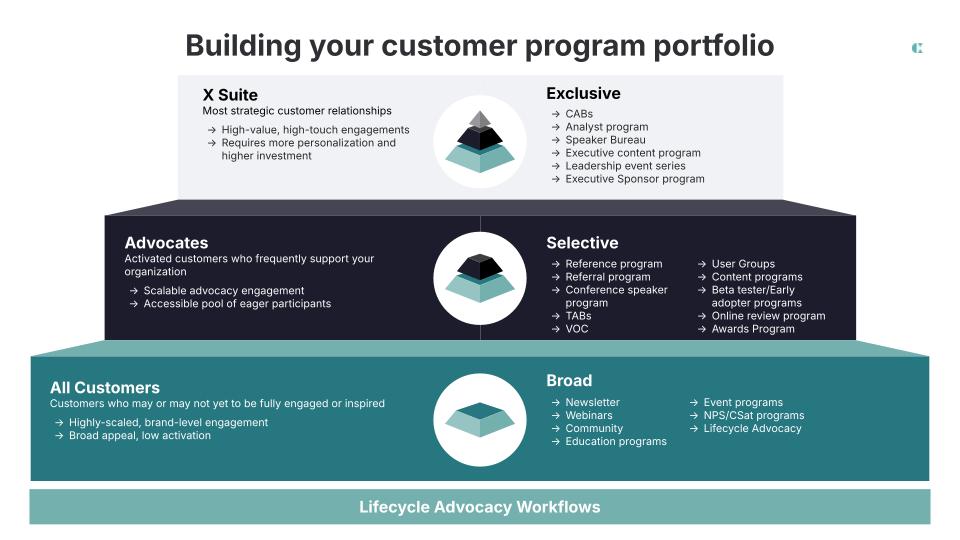
Let’s break it down into an actionable guide you can use right now.
Why a Program Portfolio Matters
A single advocacy program cannot support every customer type. At least not well, anyway. New customers need something different than long-time champions. Executives need something very different than day-to-day power users. And your pipeline? It needs proof, not swag.
A portfolio solves this by giving you a mix of engagement types:
- High-touch, high-value engagements for your most strategic relationships.
- Relationship building advocacy opportunities for your reliable champions.
- Broad, scalable engagement that nurtures the full customer base.
When these layers work together, you get predictable advocacy, a stronger reference pool, and a measurably better customer experience… all without duct-taping tactics together every quarter and scrambling to prove ROI.
The 3 Layers of a High-Performing Customer Program Portfolio
Let’s zoom into the details of each of these layers.
1. Exclusive Programs: High-Touch, High-Impact
This is your premium layer - the exclusive, white glove experiences reserved for your most strategic customers. These programs require higher personalization and tighter orchestration, but deliver major strategic value.

Examples:
- Customer Advisory Boards (CABs)
- Analyst program
- Speaker bureau
- Executive content program
- Leadership event series
- Executive sponsor program
What this layer is for:
- Strengthening high-value relationships
- Securing deep insights
- Influencing strategic roadmap direction
- Showcasing customer leadership
Pro Tip: If everything feels “Exclusive,” nothing really is. Keep this layer tight. Think 1–5% of your customer base. It should feel selective, something customers aspire to.
Actionable Steps:
- Build a clear process for selecting accounts.
- Create a quarterly executive-level engagement rhythm.
- Align with your product leadership on how feedback will be actioned and communicated back.
2. Selective Programs: Your Advocacy Workhorses
This is the engagement layer where your activated customers live, the ones who are eager to share, help, participate, and amplify.
These programs are scalable but still curated, making them ideal for helping Sales, Marketing, and Product build credibility and momentum.

Examples:
- Reference programs
- Referral program
- Conference speaker program
- Technical Advisory Boards (TABs)
- Voice of Customer (VoC)
- User groups
- Content programs
- Beta / early adopter programs
- Online review program
- Awards program
What this layer is for:
- Feeding references into the pipeline
- Creating content proof (reviews, stories, webinars)
- Gathering feedback that’s more specialized
- Engaging known superfans or repeat contributors
Pro Tip: Don’t just ask for favors, offer meaningful value upfront. You need to invest before you can withdraw, or you’ll go into advocacy overdraft. And just like managing your money, you will pay for negative balances! Give early access, insider updates, or leadership visibility. The best advocates stick around because they feel invested and valued, not used.
Actionable Steps:
- Build a campaign with simple, low-friction asks.
- Create a quarterly “customer content sprint” to fuel stories, quotes, or videos.
- Launch a consistent review-generation program tied to key business moments (renewals, milestones, releases).
3. Broad Programs: Your Scalable Customer Engagement Engine
This is your widest layer and includes the programs that reach your entire customer base, including those not yet engaged. Yes, even your quiet lurkers need to be included!
These programs nurture relationships, build product literacy, and feed all the other layers of your portfolio.

Examples:
- Newsletter
- Webinars
- Community
- Education programs
- Event programs
- NPS/CSAT programs
- Lifecycle advocacy campaigns
What this layer is for:
- Building broad awareness and participation
- Nurturing customers into readiness for higher-touch programs
- Collecting data, sentiment, and signals
- Supporting product adoption at scale
Pro Tip: Your broad layer isn’t “nice to have.” It’s your talent pipeline. Most future advocates are hiding here — watching quietly, learning, and waiting for the right moment.
Actionable Steps:
- Monitor engagement signals (comments, webinar questions, community activity).
- Use onboarding and lifecycle campaigns to identify rising advocates.
- Include “lightweight advocacy moments” in newsletters and communities (polls, quick wins, micro-asks).
Advanced practitioners not only monitor engagement signals, but also operationalize responses to the signals. Not sure how to level up? Check out our Vendor Resources or reach out to the team. Many CMA vendors have native workflows built specifically for this.
How to Prioritize Efforts When Building a Portfolio
All marketers are being tasked with doing more with less. We get it, this can feel very overwhelming, but we have been through this with many clients, and these are our tips for how to prioritize your efforts for maximum efficiency when building a program portfolio.
Clarify who belongs where
Map your customers across the three layers based on criteria like ARR, influence, experience, and engagement history.
Start with what you already have
You don’t need to launch new programs overnight. Audit your existing activities and assign them to portfolio layers.
Plug gaps intentionally
Missing a reference program? A CAB? A consistent review motion? Choose 1–2 gaps to prioritize each quarter.
Build cross-functional alignment
Educate Sales, CS, and Product on what each layer is for — and where they should route customer opportunities. Clarity reduces chaos.
Make movement between layers easy and natural
A customer might start in your community, join a user group, then become a reference, and eventually sit on a CAB. A good portfolio makes those transitions seamless.
Pro Tip: Your job isn’t to run every program personally, it’s to be the conductor, orchestrating the system to create a beautiful, interactive eco-system of advocacy. Share ownership, build mutually beneficial goals, and empower your teams.
.jpg)
What Great CMA Teams Do Differently
Ever wanted a glimpse inside the powerhouses of advocacy, to see how they do what they do? Here is your chance based on our experiences working with global powerhouses and leaders in advocacy. High-performing teams:
- Map activities to their outcomes (vs. doing “advocacy stuff”).
- Use their Broad layer to find future champions.
- Treat Selective programs as engines for growth and expansion.
- Treat Exclusive programs as strategic assets, and protect them at all costs.
- Design experiences that match customer maturity.
- Clearly communicate their portfolio (and its strategic alignment to company priorities) back to leadership.
In other words? They don’t treat advocacy like a single program or platform, they treat it like an ecosystem that grows with their customers and their business.
Want to learn more? See how Kevin Lau at Freshworks and Kevin Scanlon at SAP use the Advocacy Portfolio Program Pyramid, then book a chat with our team for more insights on how you can level up.
The Bottom Line
If your customer programs feel scattered, reactive, or overly dependent on one channel or platform, a portfolio approach is your new secret weapon. The structure of our Captivate Customer Program Portfolio Pyramid gives CMA pros a strategic blueprint: build broad reach, deepen selective engagement, and elevate the experiences of your most strategic relationships.
Do that and you’ll create a customer engine that’s scalable, sustainable, and consistently effective.